(This was first posted on February 15, 2023. I am moving it here to port some old posts to the new website.)
We are planning to move later this year, and I am really hoping to be able to have a garden again. I grew up gardening, but we haven’t had one in decades because of living in apartments in cities and moving every few years (although I have always grown potted plants in our apartments). If things work out and we are able to get a place, it will be too late in the year to be able to plant much. I was thinking about what could be planted in the fall, and garlic came to mind. Garlic requires a period of cold weather to start growing correctly (vernalization) and can be planted in the fall for the next year. I’ve grown plenty of onions in the past but have never really grown garlic myself, so I started looking up some information about garlic, starting with what possible varieties to plant, and I ended up down this rabbit hole to share.
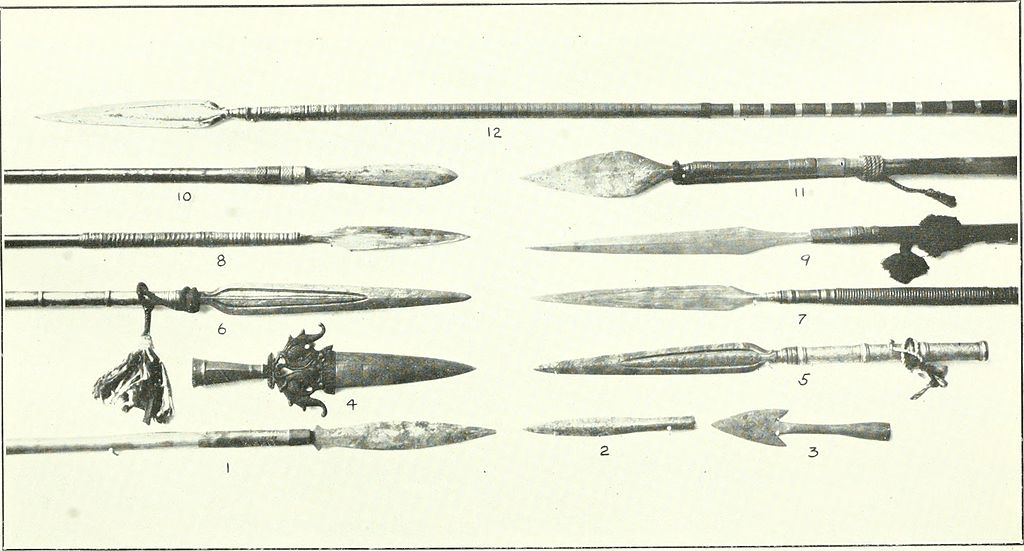
In Old English, gar means spear. It comes up occasionally in a few words like the name Garret (someone with a spear) and gore (to stab with a spear).
A lot of English and German words share a common origin; however, the meaning and pronunciation have often shifted over the centuries. For example, Tish means table in German but dish in English. The ideas are related, a place to eat food, but the meanings have shifted from each other. Part of the trick in learning German is to map the right words to each other. Mädchen for girl (maiden), Hund for dog (hound), and so on.
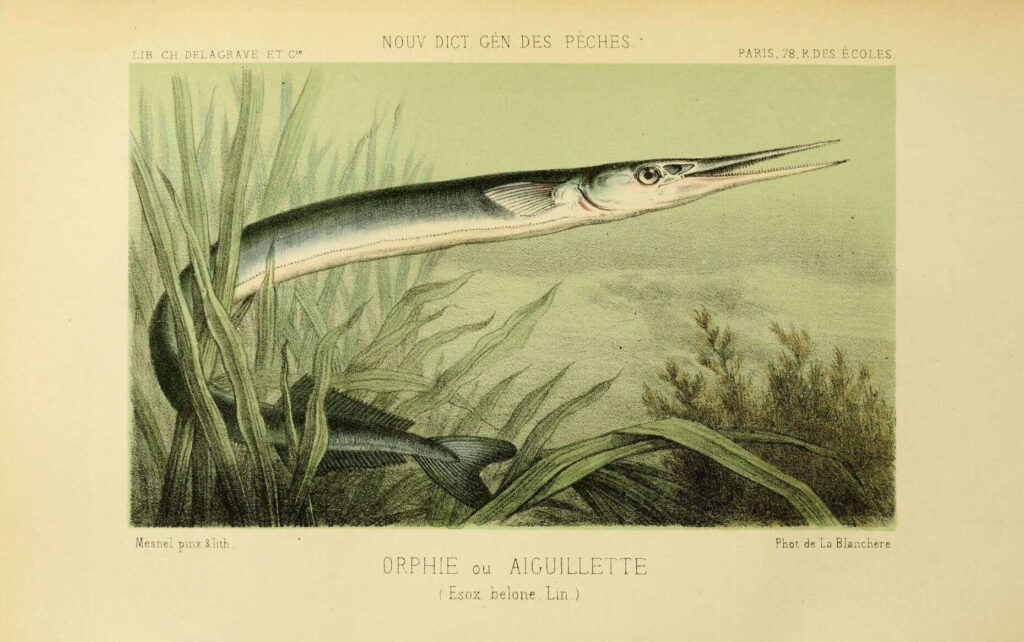
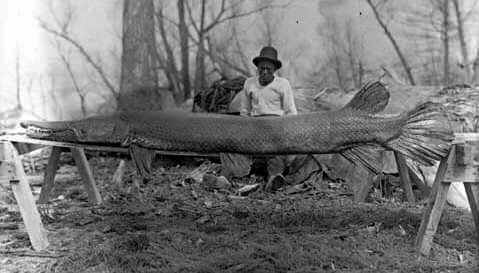
Germany has Garfisch (Belone belone) in the Atlantic and Baltic, but these are completely different from the gar fish we have in the US; again, a related idea, but the definition has shifted. German garfish are long and thin, a needlefish (Belonidae). American gar (Lepisosteidae) are big and broad and very distantly related. The largest of these, the alligator gar (Atractosteus spatula), is a dramatic example. They are living logs. You would not want to try to throw one like a spear. (Years ago, I got into a discussion with a German fishing on the Baltic about what the best way was to refer to these fish (Belone belone) in English, needlefish versus garfish.)
The German name Garfisch makes perfect sense if you remember that gar means spear. German garfish, spear-fish, are shaped like long thin pointy javelins.
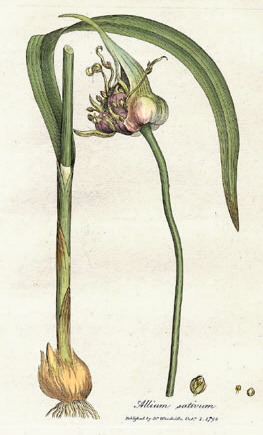
In Old English lēac meant onion, but the word descendant is now used for the onion-relative leek (which is Lauch in German). Garlic has a hard flower stalk (scape) that grows from the center of the cluster of cloves (in hardneck varieties, these are missing in softneck garlic). So, what did the English call these onion-like vegetables with hard long stalks, the end of which widens and then comes to a long tapering point like the blade of a spear—spear-onions or gar-lēac, which is our modern word for garlic.
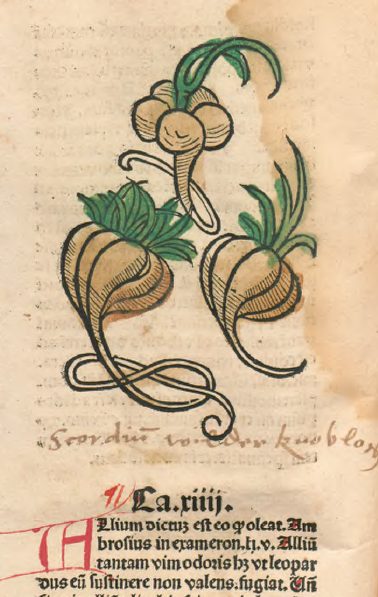
The Ortus Sanitatis (or Hortus Sanitatis, “Garden of Health” in Latin) was a natural history book published in Germany in 1491 at the end of the Middle Ages. In addition to real species, it contains some mythological animals as well as mistakes for actual species. I can’t read Latin and it is a long book, so I searched through a PDF scan of the book that is available online with the term “allium”; the Latin word for the onion genus Allium, which includes onions, garlic, and leeks, and found the image that is at the top of this post. It appears to have “knoblo…” written under it, which is likely the modern German word for garlic, Knoblauch (knob-leek). On the next page, I found “allium serpentis“. (It uses the long s, ſ, which is no longer used and looks like an f to us today, so serpentis was written as ſerpentis.)
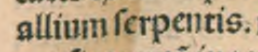
This appears to be referring to “serpent garlic” corresponding to the modern ophioscorodon varieties (from Anceint Greek ophis, ὄφις, for snake—just to throw another language in here) or hardneck types with a scape.
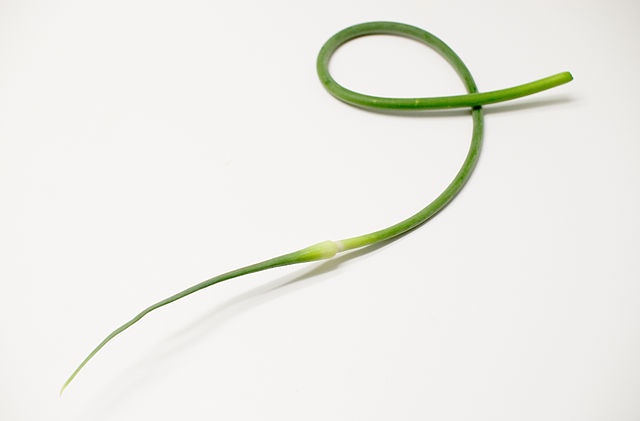
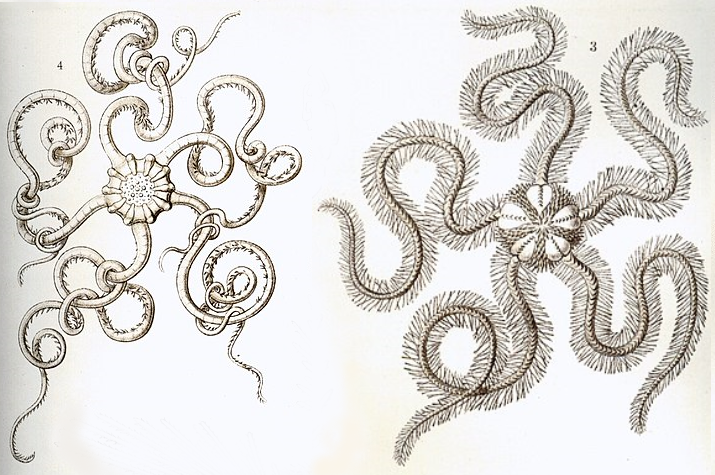
Ophioscorodon garlic scapes are often twisted or coiled like a snake (and can be used in cooking for a garlic flavor), thus the serpent name. Incidentally, the scientific name for brittle stars is Ophiuroidea which means serpent tail in Greek (ὄφις-οὐρά), referring to the long winding arms. (This connection, referring to brittle stars as snake-like in Greek, was pointed out to me years ago by a marine biologist.)
Medieval books were copied from copies of copies, often from descriptions of descriptions, with some details, especially of animals, strangely evolving over time because the actual animals had not been seen by the authors for generations. Here are a crocodile and a narwhal as examples. Note the ears, among several other details.
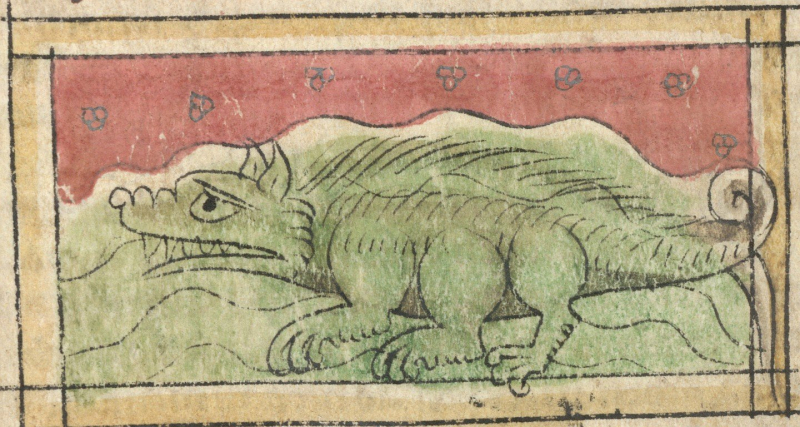
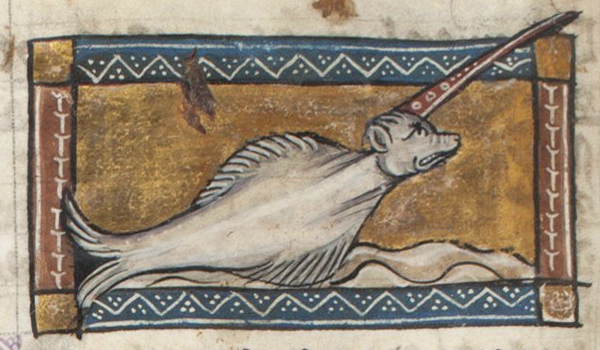
The unknown author of the Ortus Sanitatis seems to have mistaken the serpent part of garlic (other mistakes in the manuscript have been noted over time).
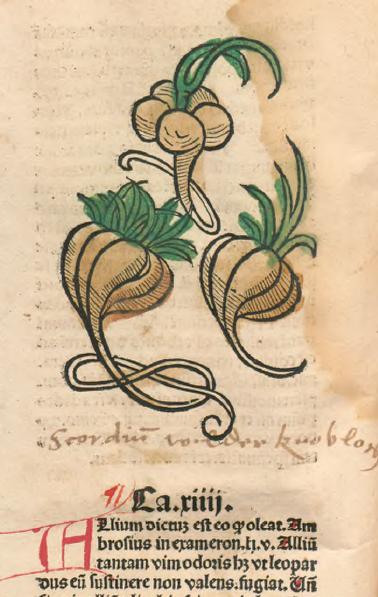
The roots of the garlic, rather than the scapes, appear to be the long curved part of the plant in the illustration (or is the plant drawn upside down?). This seems a bit strange because garlic, unlike crocodiles or narwhals, should have been around and easily observed in 15th-century Germany. However, today we are, of course, not immune to the accumulating errors of copying, even with things we are directly exposed to. When you get information from several people about how you are supposed to do something, like growing garlic for example (the correct varieties, spacing, depth, time of planting, watering, type of mulch, cutting scapes, companion plants, health effects, etc.), you quickly realize that conflicting advice cannot all be right or the only good way to do things, and extra or incorrect steps work their way in over time. When getting into other subjects like raising chickens, growing tomatoes, and getting rid of pests, you can quickly see where superstitions come from—do these things that people say need to be done or not done actually make a difference or not? I suppose the point of this is to remind myself to keep an open, reasonably skeptical mind and try to strike a balance between listening to information (we can’t test everything all of the time) and trying some things out and experimenting firsthand. Hopefully, I can get started doing that with garlic this fall.
Links, media information, resources, and references:
- Garlic on Wikipedia, https://en.wikipedia.org/wiki/Garlic
- Ortus Sanitatis (or Hortus Sanitatis), 1491, Mainz, Jacob Meydenbach.
- Wikipedia article, https://en.wikipedia.org/wiki/Hortus_Sanitatis
- Cambridge University Library, https://cudl.lib.cam.ac.uk/view/PR-INC-00003-A-00001-00008-00037/1
- PDF available at The National Library of Medicine, http://resource.nlm.nih.gov/9413026
- Rare Books & Special Collections Library, The University of Sydney, https://web.archive.org/web/20121211024321/http://www.library.usyd.edu.au/libraries/rare/treasures/tour-hor.html
- Spear image; Kriger, H. W., 1926, The collection of primitive weapons and armor of the Philippine Islands in the United States National Museum, Smithsonian Institution, United States National Museum, Bulletin 137, plate 6, Washington Government Printing Office.
- Garfish, Belone belone, illustration; De La Blanchère, H., 1868, La Pêche et les poissons: nouveau dictionnaire général des pêches, Paris, C. Delagrave et cie, plate 30.
- Alligator gar image; Franklin, D., 1910, Moon Lake, Mississippi, American Museum of Natural History, negative 117075.
- Hardneck garlic illustration; Woodville, W., 1793, Medical botany, London, James Phillips, 1st edition, volume 3, plate 168.
- Coiled garlic scape image; Canterel, 2007, https://commons.wikimedia.org/wiki/File:Garlic_scape.jpg
- Brittle star illustration, modified; Haeckel, E., 1904, Kunstformen der Natur, plate 10: Ophiodea. https://en.wikipedia.org/wiki/Brittle_star#/media/File:Haeckel_Ophiodea.jpg
- Medieval crocodile illustration; Sloane 3544, 13th century, f. 43r, British Museum.
- Medieval narwhal illustration; van Maerlant, J., ca. 1350, Der naturen bloeme, National Library of the Netherlands.
- Epicurious article on cooking with garlic scapes, https://www.epicurious.com/ingredients/how-to-make-the-most-of-garlic-scapes-article
- Allrecipes.com garlic scape recipes, https://www.allrecipes.com/recipes/17888/fruits-and-vegetables/vegetables/garlic/garlic-scapes/
_(19883537584).jpg)


Leave a Reply