I picked up this book, 1177 B.C.: A Graphic History of the Year Civilization Collapsed (2024) by E. H. Cline and G. Fawkes, in an airport bookstore because it looked like it might be interesting and different from the type of books I usually read. This is a graphic novel version of 1177 B.C.: The Year Civilization Collapsed (2015) by E. H. Cline, which I have heard of but have not yet read.
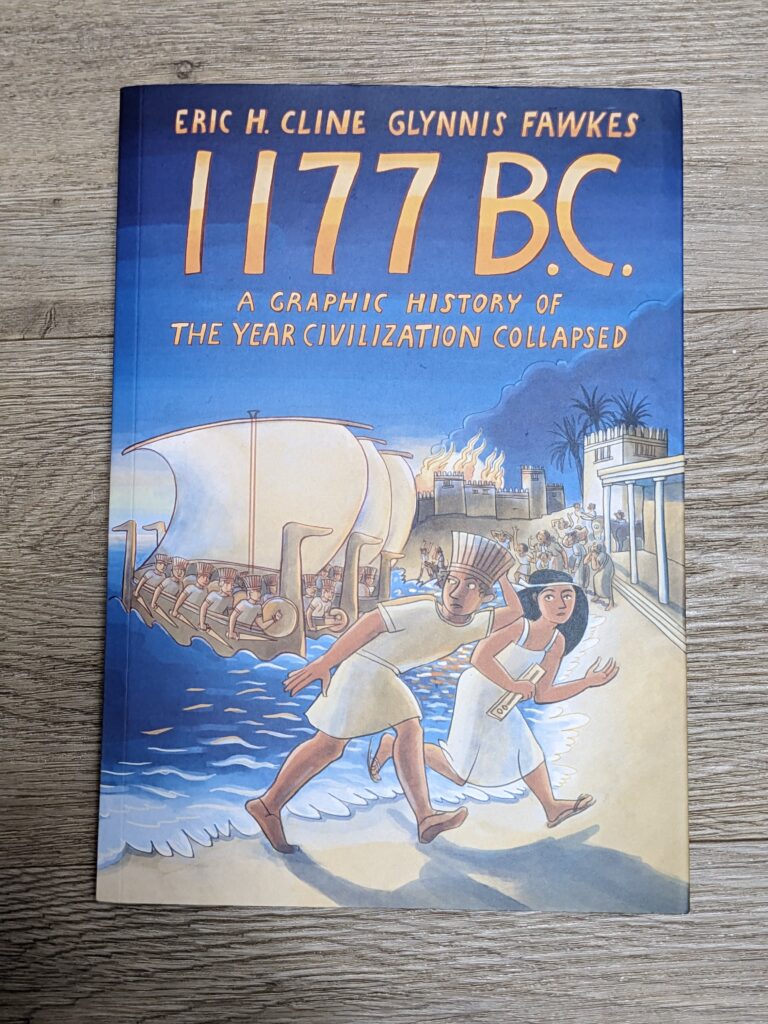
It talks about the collapse of civilizations in the Eastern Mediterranean over 3,000 years ago at the end of the Bronze Age that lead to a Dark Age, long before the later Medieval Dark Age we think of today, before these civilizations became reestablished again in the Iron Age and later led to the the Greek Classical period among other things.
This is a very early time in history compared to what we are used to thinking about. The Egyptians, Hittites, Assyrians, Mycenaean Greece and others were interconnected and increasingly interdependent with extensive trade and communication. This suddenly ended and it is a big mystery as to exactly why, which is the focus of this book. There was destruction of cities and movements of people but it is not exactly clear what the driving forces were. One possible candidate that the authors discuss is an extended period of drought and increasing aridity in the area that may have severely challenged food production, but this is just one idea among many.
My feeling is that the book is nice; it is an interesting topic and there is a lot of detail and information packed in. However, I found it a bit tedious to read. It seemed to rehash very similar ideas over and over and not flow smoothly between the topics. That being said there is a lot of fascinating detail packed in there. I feel like this is a case where less may have been more, perhaps as a hook for people to read the 2015 regular text version of the book with more details (which I have not read). If you are very interested in this topic or are looking for something different this might be a good choice but as far as just simple reading entertainment it is harder to recommend.
One side detail that I liked was on p. 53 of the book where it mentions the World War I Battle of Megiddo in 1918. General Allenby read an account of Thutmose III’s battle at Megiddo and employed the same tactics and it worked, again; he won the battle. It mentions how the phrase “those who don’t study history are doomed to repeat it” can also work in reverse. Those who do study history can benefit from the knowledge.
Link
Vocabulary
- Contretemps, a dispute or unlucky occurrence. p. 98
- Hoi polloi, the common people. p. 198
- Pequod, the name of the ship in Moby-Dick. p. 229
- Philologist, a person that studies the authenticity and meaning of oral and written records. p. 14
- Regnal, refers to the period of a monarchs reign. p. 50
- Unguent, a thick oily substance to put on wounds. p. 121
Leave a Reply